Resources
A structured body of work on runtime governance — how systems decide what is allowed to happen at execution time across AI, APIs, and workflows.
Downloadable resources for governed AI in regulated environments
Whitepapers, briefs, workflow proof packs, and evaluation materials for teams building AI into clinical, legal, fintech, and other high-stakes workflows.
Built for enterprise buyers who need sharper artifacts than a product page.
Start here
If you're new to LSAS, this sequence walks through the model from concept to execution.
Runtime Governance for Regulated AI
Why policy-only governance breaks in production
Open resource(opens in a new tab)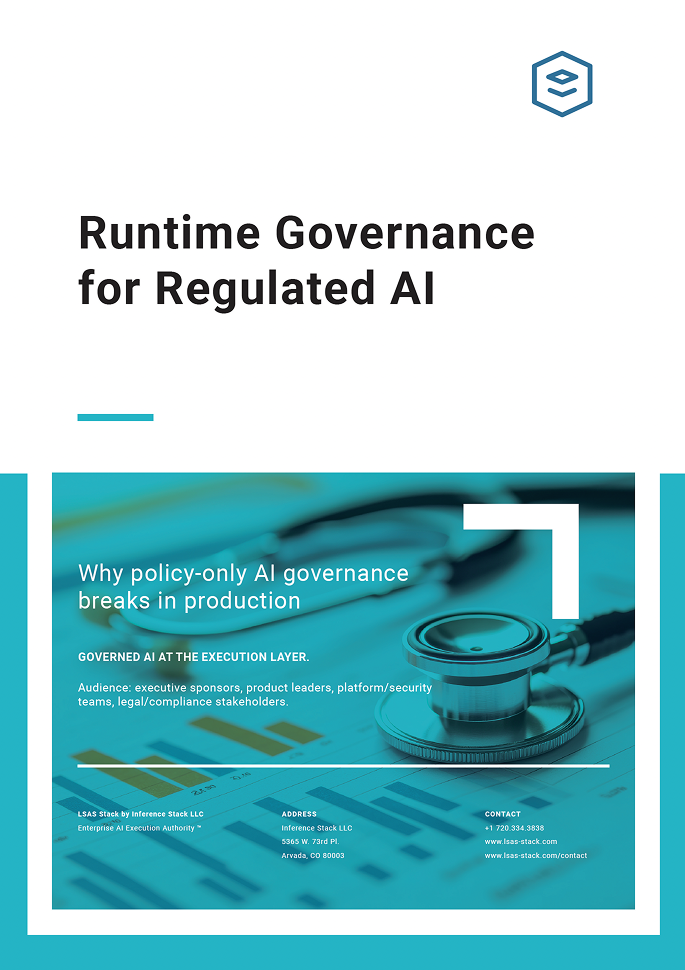
Authority at Runtime
What systems are allowed to say, do, and rely on
Open resource(opens in a new tab)
Alignment Before Autonomy
Why governance breaks down across teams
Open resource(opens in a new tab)
Flagship whitepaper
Runtime Governance for Regulated AI
Why policy-only AI governance breaks in production
A category-defining whitepaper on why high-stakes AI needs runtime control, evidence thresholds, deterministic validation, and proof of findings-not just policy documents and audit logs.
- Why policy-only governance fails at execution time.
- Where LSAS fits between applications, agents, APIs, and systems of record.
- What runtime proof looks like after allow, constrain, abstain, or escalate decisions.
- Why regulated teams need more than auditability to operationalize AI safely.
Featured cover
Governed AI at the execution layer for regulated and high-stakes workflows.
Download the flagship whitepaper as a PDF now.
Resource library
Resource library
Forwardable collateral for executive, technical, governance, workflow, and evaluation conversations.
Showing 7 of 7 resources
Runtime Governance for Regulated AI
Why policy-only AI governance breaks in production
A category-defining whitepaper on why high-stakes AI needs runtime control, evidence thresholds, deterministic validation, and proof of findings-not just policy documents and audit logs.
Governed Workflows in Practice
Clinical, legal, and fintech scenarios from the LSAS sandbox
A scenario-driven proof pack showing how governed AI behaves in representative high-stakes workflows, including clinical note handling, legal citation-sensitive drafting, and payment-adjacent data controls.
Evaluating LSAS in Your Environment
A practical guide to scoped evaluation, rollout planning, and proof of readiness
A guide for serious buyers on how to evaluate LSAS through one workflow, one boundary, one definition of done, and a reviewable artifact set instead of vague rollout language.
Inside LSAS
How deterministic validation, policy packs, escalation, and audit telemetry work
A technical architecture brief covering the six-step runtime pipeline, decision envelopes, control surfaces, deployment boundaries, and how LSAS translates governance into explainable execution.
Authority at Runtime
What AI is allowed to say, do, and rely on - under what conditions
A governance brief for teams defining runtime authority, evidence sufficiency, release conditions, escalation logic, and proof requirements for AI-assisted workflows.
Alignment Before Autonomy
How legal, compliance, security, product, and engineering align around governed AI
An organizational alignment brief that turns governance from vague agreement into clear ownership, shared definitions, operating cadence, and executable policy decisions.
LSAS Applied Governance Engagement
A 12-week scoped engagement for one high-stakes workflow or boundary
A one-pager describing a bounded applied-governance engagement that aligns control objectives, implements runtime governance for a chosen boundary, and produces reviewable governance artifacts and a path to rollout.
Answer set
What these resources help you answer
What is runtime governance, and why is it suddenly urgent?
Runtime governance becomes urgent when AI moves from demos into workflows where outputs trigger regulated actions, customer impact, or legal exposure.
How does LSAS translate policy into runtime behavior?
LSAS maps policy packs and deterministic validators to explicit decisions with evidence thresholds, escalation logic, and release controls.
What proof should exist after AI output is allowed, changed, withheld, or escalated?
Each decision should carry auditable evidence: findings, thresholds, remediation steps, and traceable metadata tied to a policy version.
What does a serious first evaluation look like in a real environment?
A serious evaluation starts with one workflow, one boundary, one definition of done, and a reviewable artifact set for executive and governance stakeholders.
Start with one workflow, one boundary, and one definition of done.
Explore LSAS in your environment or run through the sandbox to see how decisions are evaluated at runtime.
Related links
Move from policy language to governed execution.
Explore the Sandbox, download the resource set, or schedule a working session to scope the first workflow or boundary.